Supported and endorsed by:
Sailing Skills for Future Yacht Crew
Sailing Course
Only $55Once-off Payment
From First Tack to Full Command
With dozens of practical lessons and drills, the Sailing Course gives you a thorough, confidence-building foundation — ideal for future yacht crew who want to understand sailing operations, navigation basics, collision regulations, and seamanship before stepping onboard.
Sailing Course
Reference Material
Reference Material: This library contains all essential resources and documents to support your studies, including:
- Comprehensive Glossary of Nautical Terminology
- Maritime Industry Acronyms
Materials Provided
This module covers the technical words and terms used in the forthcoming sailing training videos, designed to expand your knowledge and understanding to prepare you to enter the maritime industry.
-
Lesson 1:Vessel Parts Terminology
-
Lesson 2:Sailing Terminology
-
Lesson 3:Sails and Manoeuvring Terminology
- Module Test
This module introduces the basics of sailing theory and expands on the terminology learned in Module 1.
-
Lesson 1:Hull Type
-
Lesson 2:Keel Type
-
Lesson 3:Mast Configurations
-
Lesson 4:Vessel Parts
- Learning Activity: Vessel Parts
-
Lesson 5:Rigging
-
Lesson 6:Sails
-
Lesson 7:How Wind Acts on a Sail
-
Lesson 8:Basic Manoeuvres
-
Lesson 9:Points of Sail
- Module Test
This module aims to introduce you to the Collision Regulations 'COLREGs' focusing on the main rules needed to sail a vessel safely in hours of daylight. However, the sooner you begin to familiarise yourself with the COLREG’s and begin to learn and understand them, the safer you will be at sea, and the faster you will excel in your maritime career.
-
Lesson 1:COLREGs Part A
-
Lesson 2:COLREGs Part B - Section I
-
Lesson 3:COLREGs Part B - Section II
-
Lesson 4:COLREGs Part B - Section III
-
Lesson 5:COLREGs Part C
-
Lesson 6:COLREGs Part D
-
Lesson 7:COLREGs Part E & Part F
-
Lesson 8:COLREGs ANNEXES
- Module Test
Understanding the basics of chart work will help you better understand what is required to navigate safely at sea.
-
Lesson 1:Instruments
-
Lesson 2:Charts
-
Lesson 3:Symbols and Abbreviations
-
Lesson 4:Distance, Speed, Time, and Direction
-
Lesson 5:Plotting
-
Lesson 6:Position Fixes
- Module Test
Passage/voyage planning is the procedure used to develop a complete description of the vessel's voyage from departure to arrival or ‘berth to berth’. Passage plans provide all the necessary information to navigate the vessel safely. Therefore, it should be comprehensive, detailed, and easy to understand.
-
Lesson 1:Principles of Planning
-
Lesson 2:Stage Planning
-
Lesson 3:Execution
-
Lesson 4:Monitoring
- Module Test
The IALA Maritime Buoyage System is in place to improve navigational safety and to act as a barrier to dangers. When entering or exiting a port, vessels need to understand where the safe water is to navigate and the potential hazards to avoid collisions. To achieve this, we use aids to navigation; these may be buoys, lighthouses, lightships, or other fixed or floating devices.
-
Lesson 1:Lateral Marks
-
Lesson 2:Cardinal Marks
-
Lesson 3:Isolated Danger Mark
-
Lesson 4:Safe Water Mark
-
Lesson 5:Special Marks
-
Lesson 6:New Danger Mark
-
Lesson 7:Other Marks and Rules
- Module Test
This module provides a theoretical understanding of operating the CNB Lagoon 620 sailing vessels in a safely and efficiently. By following steps for each action, you will limit any risk of endangering yourself, the vessel, or your fellow crew members. Practical training will reinforce this learning.
-
Drill 1:Lowering the Boom
-
Drill 2:Hoisting the Mainsail
-
Drill 3:Reefing the Mainsail
-
Drill 4:Shaking Out a Reef
-
Drill 5:Dropping the Mainsail
-
Drill 6:Lifting the Boom
-
Drill 7:Genoa / Staysail: Unfurling
-
Drill 8:Genoa / Staysail: Furling
-
Drill 9:Hoisting the Code Zero
-
Drill 10:Deploying the Code Zero
-
Drill 11:Furling the Code Zero
-
Drill 12:Heavy Weather / Overnight Preparedness for the Code
- Module Test
This module provides a theoretical understanding of how to operate a monohull sailing vessels safely and efficiently. By following steps for each action, you will limit any risk of endangering yourself, the vessel, or your fellow crew members. Practical training will reinforce this learning.
-
Drill 1:Bending on the Mainsail
-
Drill 2:Hoisting the Mainsail
-
Drill 3:Lowering the Mainsail
-
Drill 4:Reefing the Mainsail and Shaking Out a Reef
-
Drill 5:Bending on the Jib
-
Drill 6:Unfurling and Furling the Jib
-
Drill 7:Tack
-
Drill 8:Gybe
-
Drill 9:Goosewing
- Module Test
After completing this module, you will know in theory how to maintain the standing and running rigging of the monohull and catamaran vessels. The maintenance concepts are relatively universal across all vessel types, and following the schedule is imperative to extend the working life of your rigging while keeping you safe at sea.
-
Lesson 1:Products used in the Spars and Rigging Procedure
-
Lesson 2:Tools
-
Lesson 3:Catamaran Rig Visual Maintenance
-
Lesson 4:Catamaran Rig Physical Maintenance
-
Lesson 5:Monohull Rig Visual Maintenance
-
Lesson 6:Monohull Rig Physical Maintenance
-
Lesson 7:Winch Service
- Module Test
The score for this course contributes towards an average final score after completing all the courses.
Reference Material
Reference Material: This library contains all essential resources and documents to support your studies, including:
- Comprehensive Glossary of Nautical Terminology
- Maritime Industry Acronyms
Who This Sailing Course Is For:
- You want to understand sailing fundamentals before committing to costly training or career decisions.
- You’re considering a yachting career and want practical insight into sailing, seamanship, and onboard expectations before investing further.
- You’re new to yachting and want to feel more confident and prepared before stepping onboard for the first time.
- You’re a career changer looking for structured, trustworthy training
- You’re currently working onboard and want to upskill without disrupting your schedule
- You’re a senior crew member who wants to train junior team members efficiently with minimal time spent away from duties
- You want to avoid wasting time and money on unnecessary courses by building the right sailing foundation first.
What You Get:
- Professionally structured online course developed by industry experts
- Quick-reference guides
- Real-world examples and visual demonstrations throughout
- Interactive learning experience with scenario-based content
- 12 months of unlimited access — learn anytime, anywhere
- Certificate of completion
- A practical onboard training tool for individual upskilling or team development
Know Your Industry Options – Learn More
If you are not sure about starting a long-term career in the Luxury Yacht Industry access the world’s most comprehensive and succinct career guidance tool here, and find out what to do, when to do it, and where to do it, at your own pace.
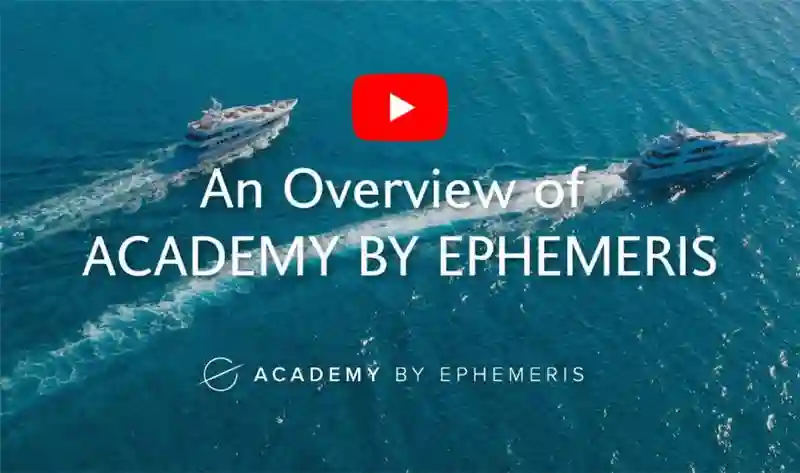
Watch the Overview Video below or visit the
Academy by Ephemeris Website
Still Not Sure Where to Start?
We recommend starting with the Introduction to Yachting Course.
This course gives you a clear understanding of how the industry operates, what each department does, and which career pathways may suit you before progressing further.